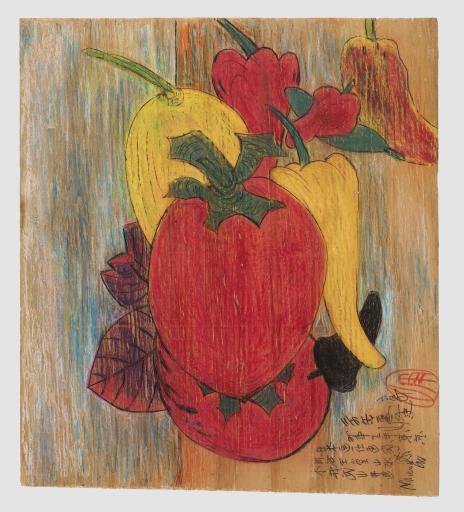
untitled (“Gionbō” persimmons and vegetables), Jimmy Tsutomu Mirikitani

Artwork Overview
1920–2012
untitled (“Gionbō” persimmons and vegetables), date unknown
Where object was made: United States
Material/technique: drawing; ballpoint pen; colored pencil; wood
Credit line: Collection of Linda Hattendorf, Taos, New Mexico
Accession number: EL2024.185
On display: Perkins Central Court

If you wish to reproduce this image, please submit an image request

Images

Label texts

Street Nihonga: The Art of Jimmy Tsutomu Mirikitani

The Japanese term ita-e (板絵), meaning “painting on wood,” refers to works executed directly on wooden panels rather than on silk or paper. Traditionally used for Buddhist icons and small devotional objects, ita-e exploit the natural grain of the wood as part of the composition. Mirikitani reimagined this practice through his use of salvaged plywood as both support and symbol. Working in colored pencil and pen, he sometimes added collage elements, such as photographs, to create richly layered scenes. By transforming discarded plywood into a surface for art, Mirikitani extended the ita-e tradition into a contemporary act of improvisation and expressive vitality.

Exhibitions

Kris Ercums, curator
Maki Kaneko, curator
2026