Street Nihonga
日本語のオンライン展覧会ページは、こちらからご覧いただけます。
Born in Sacramento, California and raised in Hiroshima, Japan, Jimmy Tsutomu Mirikitani (1920–2012) lived a life shaped by displacement, resilience, collaboration, and creativity across borders. Trained in Nihonga (“Japanese-style” painting) in prewar Japan, he returned to the United States in 1940 and endured wartime incarceration at Tule Lake, the loss of family and friends in Hiroshima to the atomic bombing, and decades of statelessness and homelessness in postwar New York City. His art—spanning painting, drawing, collage, and mixed media—became both a survival strategy and a means of transforming memories of his transpacific journey and Japanese American experiences into shared testimony.
Street Nihonga sheds light on Mirikitani’s creative practice, intertwining artmaking, life narration, and street activism through the largest assembly of his works to date. The exhibition unfolds through six thematic sections: Sidewalk Stories, Street Nihonga, Tule Lake Memory-Scape, Multiple Ground Zeros, Affinities and Connections, and Entangled Memories. Rather than following Mirikitani’s artistic journey chronologically, each section illuminates a distinct aspect of his practice, inspired by his own collage-based approach to art.
Each section presents a selection of works accompanied by interpretive texts—some adapted from the catalogue co-written by Mirikitani’s closest friends, advocates, and documentarians, Linda Hattendorf and Masa Yoshikawa, as well as the curator—together with short video works that Hattendorf created specifically for the exhibition. This virtual exhibition also features an interactive map, inviting viewers to envision and retrace Mirikitani’s experiences. It expands on the artwork and ideas presented in our Street Nihonga in-gallery exhibition, which runs February 19–June 28, 2026.
This virtual exhibition was created by Maki Kaneko, Kris Ercums, Daisuke Murata, and Ryan Waggoner.

Jimmy Tsutomu Mirikitani, untitled (“Mt. Fuji” and flames in homage to Hayami Gyoshū), after 2001, Museum purchase: R. Charles and Mary Margaret Clevenger Art Acquisition Fund, 2020.0221
Video Introduction
In this video, filmmaker Linda Hattendorf reflects on her relationship with Jimmy Tsutomu Mirikitani and the experiences that shaped him as an artist. Mirikitani’s life, stretching from his childhood in Hiroshima to years of homelessness in New York, was marked by wartime displacement, loss, and extraordinary resilience. Hattendorf traces how his incarceration during WWII, and the tragedies that followed emerged throughout his drawings, collages, and mixed-media works. With archival footage and intimate views of his art, the video shows how Mirikitani turned a lifetime of movement and struggle into powerful visual testimony.

Jimmy Tsutomu Mirikitani, untitled (cat with fish and peppers), date unknown, Collection of Linda Hattendorf, Taos, New Mexico, EL2024.141
Sidewalk Stories
The sidewalks and parks of New York served as Jimmy Tsutomu Mirikitani’s studio, gallery, and meeting place. Through a steady practice of drawing and collage, Mirikitani sustained his daily life while sharing his signature cat drawings and autobiographical “life documents” with engaged passersby.

Satō Tesurō, Jimmy Tsutomu Mirikitani on the streets, 1990s, Courtesy of the artist, EL2025.060
Street Nihonga
Mirikitani engaged with and transformed Nihonga, a modern school of painting that emerged in late 19th-century Japan, in response to the materials and encounters of street life. This section illuminates the ways in which he forged a border-crossing form of “street Nihonga”—a fusion of Japanese painting, urban material culture, and the collaborative spirit of Lower Manhattan.

Jimmy Tsutomu Mirikitani, untitled (Tule Lake: artist, rabbit, woman and child), circa 2001, Collection of Linda Hattendorf, Taos, New Mexico, EL2024.155
Tule Lake Memory-Scape
In May 1942, Mirikitani was sent to the Tule Lake Relocation Center and was coerced into renouncing his U.S. citizenship. Underscoring the incarceration’s enduring impact on his life, repeated compositions of Tule Lake barracks with Castle Rock and Mount Shasta evoke the layered, evolving nature of memory.

Jimmy Tsutomu Mirikitani, untitled (Atomic Bomb Dome, Kannon, River), date unknown, MASA Collection, Tokyo, Japan, EL2025.049
Multiple Ground Zeros
Mirikitani, who directly or indirectly experienced the atomic bombings of Hiroshima and the terrorist attack in New York on September 11, 2001, turned these “Ground Zeros” into central motifs in his art. While they call for remembrance, these works also hold devastation and renewal, horror and beauty, military imagery and prayers for peace in uneasy coexistence.

Jimmy Tsutomu Mirikitani, untitled (Yasuo Kuniyoshi and rabbit), 2012, Collection of Linda Hattendorf, Taos, New Mexico, EL2024.094
Affinities and Connections
By exploring Mirikitani’s connections with other artists, this section presents the layered nature of his identity as a border-crossing artist: a Japanese American raised in Japan, a Nihonga painter active on the streets of New York City, and an artist shaped by transpacific experience. These affinities invite us to look beyond boundaries, revealing unexpected parallels that complicate fixed categories.

Jimmy Tsutomu Mirikitani, untitled (big turtle table collage), after 2002, MASA Collection, Tokyo, Japan, EL2025.051
Entangled Memories
Mirikitani weaves together memory, history, and contemporary life through collages incorporating magazine and newspaper clippings, photographs, photocopies of loved ones, and images of his artworks. These intricate compositions exemplify how he gave visual form to his life story while revealing the diverse networks and communities he forged over the course of an extraordinary life.
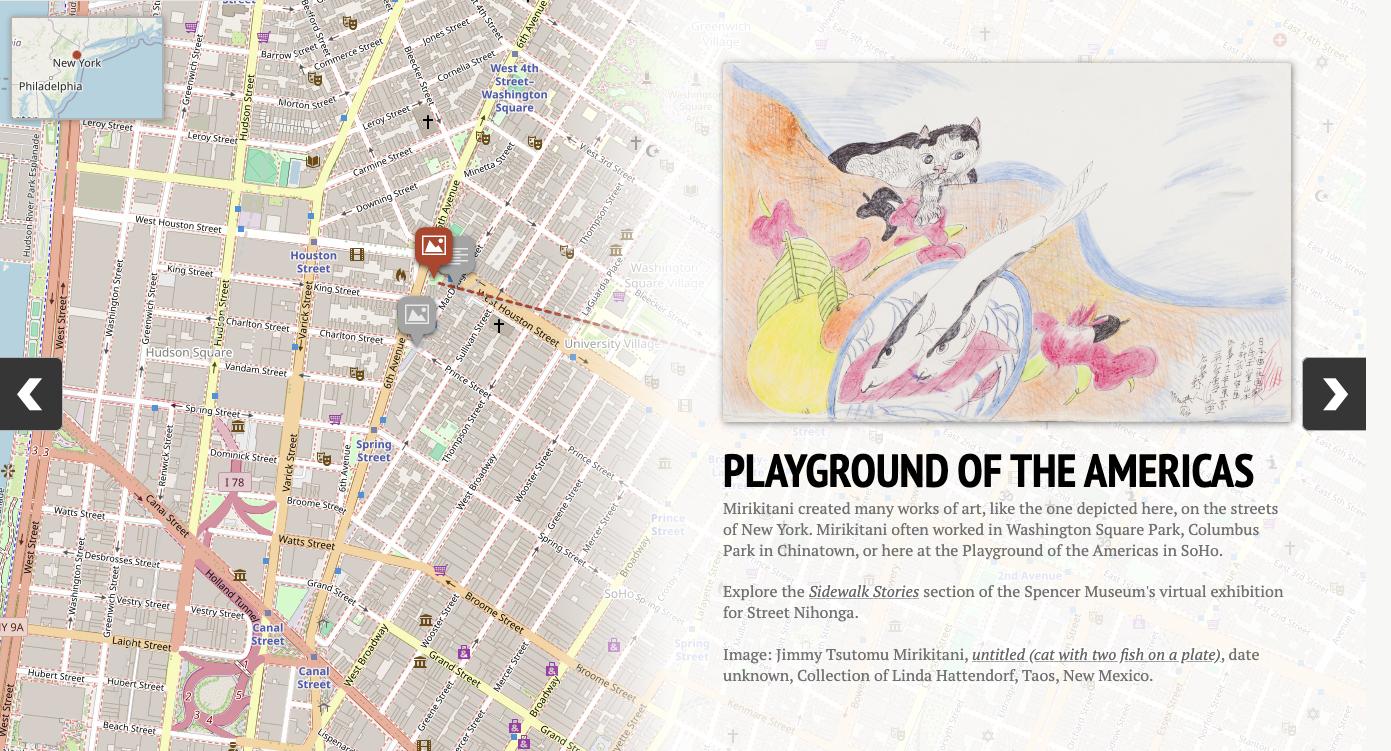
Mapping the life of Jimmy Tsutomu Mirikitani
This interactive feature maps Mirikitani's life with key sites in Japan, as well as the West and East coasts of the United States. Learn about how these places influenced his work.
Supporters
Supporters
This exhibition and related programs are supported by the Henry Luce Foundation, the Terra Foundation for American Art, the E. Rhodes and Leona B. Carpenter Foundation, the National Endowment for the Arts, the Helen Frankenthaler Foundation, the Linda Inman Bailey Exhibition and Programming Fund, the Douglas County Community Foundation, the University of Kansas Office of Research, University of Kansas Student Senate, the Kress Foundation Department of Art History, George and Hillary Hirose, Margaret Silva, Judy Paley, the International Artist in Residence Program Fund, the Marilyn J. Stokstad Spencer Museum Publications Fund, Arts Research Integration, and Friends of the Art Museum.
