Multiple Ground Zeros
The term “Ground Zero” originally referred to the hypocenters of the Trinity test site in New Mexico and the atomic bombings of Hiroshima and Nagasaki. It was later adopted to describe the site of the former World Trade Center following the terrorist attacks of September 11, 2001. Mirikitani, who directly or indirectly experienced these catastrophic events, turned two “Ground Zeros”—Hiroshima’s Atomic Bomb Dome and New York’s World Trade Center—into central motifs in his art, alongside other war-related themes.
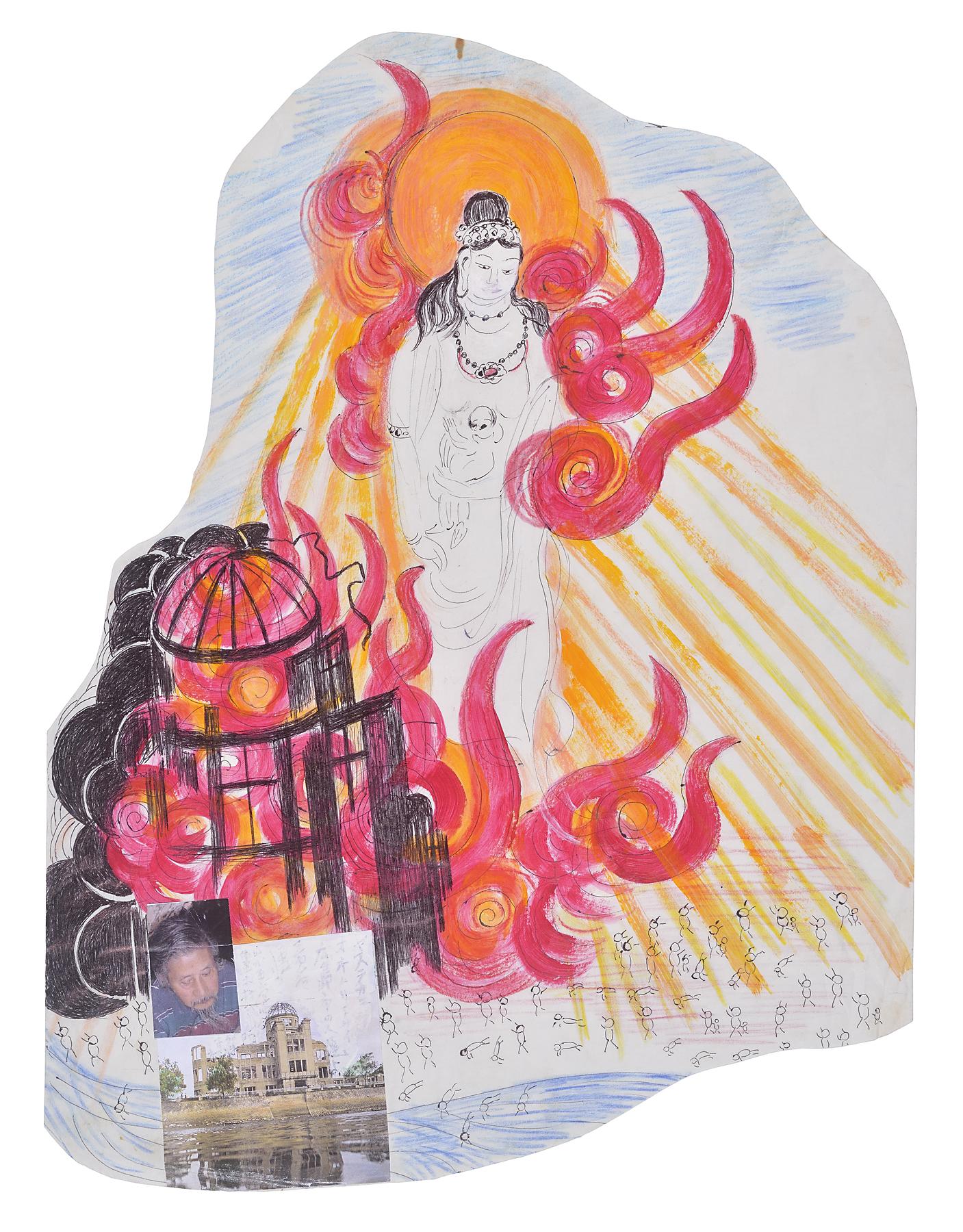
As a child, Mirikitani moved with his family to Hiroshima, where he spent his formative years. Describing himself as a Hiroshima kenjin (“a Hiroshima native”), he retained a deep attachment to the city. Although he was incarcerated at Tule Lake at the time of the bombing, members of his mother’s family and former schoolmates were killed. Its lasting impact appears in his many depictions of the fiery Atomic Bomb Dome, a half-destroyed building near the hypocenter that became a postwar symbol of peace, often paired with Kannon, the Bodhisattva of Mercy.
Living on the streets of Lower Manhattan from the late 1980s, Mirikitani witnessed the 9/11 attacks at close range. Images of the burning towers entered his visual repertoire and closely resemble his depictions of Hiroshima, suggesting that the two events intertwined in his memory and imagination.
This section presents Mirikitani’s renderings of both Ground Zeros and other scenes of destruction. While they call for remembrance, these works also resist singular meaning, holding devastation and renewal, horror and beauty, military imagery and prayers for peace in uneasy coexistence.

Jimmy Tsutomu Mirikitani, untitled (Atomic Bomb Dome, Kannon, River), date unknown, MASA Collection, Tokyo, Japan, EL2025.049
Video Introduction
This video consists of footage edited by Linda Hattendorf that was not included in her documentary The Cats of Mirikitani (2006) and reveals moments central to Jimmy Tsutomu Mirikitani’s life and work. In the aftermath of 9/11, Mirikitani visits memorials in Washington Square Park, creating art that responds to the attack on the Twin Towers. On the anniversary of the atomic bombing, Mirikitani returns to Hiroshima, visiting the Peace Memorial Park and Atomic Bomb Dome.
untitled (Atomic Bomb Dome, Kannon, River)
untitled (Atomic Bomb Dome, Kannon, River), Jimmy Tsutomu Mirikitani
untitled (Atomic Bomb Dome, Kannon, River) label
In this collage, Mirikitani juxtaposes Kannon, the Bodhisattva of Mercy, with the burning Atomic Bomb Dome in Hiroshima. Below, a photograph of the Dome taken from another angle merges seamlessly into Mirikitani’s drawn river, where stick figures line the shore, some leaping into the water. Although he was not in Hiroshima when the atomic bomb fell on August 6, 1945, its devastation profoundly affected him. Mirikitani repeatedly depicted the Dome alongside Kannon in his collage works, reflecting the enduring impact of the bombing on his life and art.
Yet this collage is exceptional. Unlike his other works, in which he used photocopies of Kannon images—presumably taken from magazine illustrations, postcards, or calendars found in New York’s Chinatown—the deity here is drawn by Mirikitani himself, underscoring the personal and haunting nature of his engagement with this memory. This connection is further deepened by a photograph of the artist inserted into the composition, placing him within the site of destruction.
Explore more
untitled (Hiroshima/World Trade Center)
untitled (Hiroshima/World Trade Center), Jimmy Tsutomu Mirikitani

untitled (Atomic Bomb Dome, Kannon, River) label
Mirikitani produced a large body of work addressing the atomic bombing of Hiroshima, frequently returning to a set of recurring motifs and compositions: the blazing Atomic Bomb Dome, stick figures of people seeking rescue, and collaged images of Kannon offering salvation. His depictions of the World Trade Center incorporate many of these same visual elements, suggesting that the two events were connected in his memory.
This piece, however, is a rare instance in which the two themes physically converge within a single image. Beside the burning Atomic Bomb Dome appears a black-and-white image of the World Trade Center. The upper section features a striking collage that includes a photograph of women in hijabs and a portrait of Osama Bin Laden. The upper right corner has a drawing of airplanes—evoking the 9/11 attacks—yet labeled USA, crashing into the Atomic Bomb Dome.
By fusing images of Hiroshima, 9/11, and the Iraq War, Mirikitani invites us to consider the interconnectedness of global atrocities—collapsing boundaries of time, place, and politics to confront the recurring cycles of violence, racism, and war, without reducing them to a clear-cut picture of enemy and foe.
Explore more
untitled (Battle of Midway)
untitled (Battle of Midway), Jimmy Tsutomu Mirikitani

untitled (Atomic Bomb Dome, Kannon, River) label
This collage centers on the Battle of Midway (June 1942), a pivotal World War II confrontation in which the U.S. Navy dealt Japan a crushing defeat, sinking four aircraft carriers and shifting the balance of power in the Pacific. Mirikitani combines painted and photographic elements to evoke Japan’s imperial and wartime past. Fiery red brushstrokes engulf a warship, transforming historical imagery into a meditation on destruction and remembrance. The central color photograph shows Shigemitsu Mamoru (1887–1975), who signed the Instruments of Surrender on behalf of the Japanese Government aboard U.S.S. Missouri on September 2, 1945. Beside it is a portrait of Admiral Yamamoto Isoroku (1884–1943), who died when his aircraft was shot down by U.S. forces over the Solomon Islands. In the upper right, Emperor Hirohito appears dressed in court regalia at his 1926 coronation. Through this layering of imperial portraiture, naval symbolism, and painterly violence, Mirikitani reconstructs fragments of national history to reveal the entanglement of war, empire, and personal memory.
Explore more
Dive Deeper: Miyajima, Itsukushima Shrine
Mirikitani visits Miyajima, where the Great Torii Gate marks the entrance to Itsukushima Shrine. Video footage from Linda Hattendorf.
Next Section

Affinities and Connections
By exploring Mirikitani’s connections with other artists, this section presents the layered nature of his identity as a border-crossing artist: a Japanese American raised in Japan, a Nihonga painter active on the streets of New York City, and an artist shaped by transpacific experience. These affinities invite us to look beyond boundaries, revealing unexpected parallels that complicate fixed categories.