Entangled Memories
Jimmy Tsutomu Mirikitani’s oeuvre includes a significant number of collages. While many of his drawings—of cats, flowers, Hiroshima, and the Tule Lake landscape—incorporate collaged elements, he also created more complex compositions using magazine and newspaper clippings, photographs, photocopies, and organic materials.
After moving off the streets and into an apartment in 2002—reuniting with family members and expanding his community, as documented in the 2006 film The Cats of Mirikitani—his collages became increasingly intricate. These works present kaleidoscopic images of his past and present, weaving together memory, history, and contemporary life through photographs of himself, his family, filmmaker Linda Hattendorf and her crew, as well as images of artworks by Mirikitani, his artist friends, and those he admired.
This section features collages primarily created after 2002, many of which have not been widely exhibited. While they reflect Mirikitani’s renewed connections with family and community in the final decade of his life, they also continue to engage themes central to his practice: Tule Lake, the atomic bombings, war, and U.S.–Japan and global politics—often layered alongside joyful portraits of those around him.
These intricate compositions exemplify how Mirikitani gave visual form to his life story without reducing its complexity to a conventional biographical narrative, revealing instead the diverse networks and communities he forged over the course of an extraordinary life.

Jimmy Tsutomu Mirikitani, untitled (big turtle table collage), after 2002, MASA Collection, Tokyo, Japan, EL2025.051
Video Introduction
This video consists of footage edited by Linda Hattendorf that was not included in her documentary The Cats of Mirikitani (2006) and reveals moments central to Jimmy Tsutomu Mirikitani’s life and work. Mirikitani meets with his cousin Janice Mirikitani (1941–2021) in San Francisco and offers a glimpse inside his apartment studio in New York.
untitled (big turtle table collage)
untitled (big turtle table collage), Jimmy Tsutomu Mirikitani

untitled (big turtle table collage) label
This is one of the most elaborate and intricate collage works Mirikitani created toward the end of his life. The collage is made on a tabletop using a range of images, photographs, photocopies, and fragments from magazines and newspapers—a clear indication that he continued to use salvaged and readily available materials creatively, even after moving off the streets.
Surrounding a drawing of a large turtle—a symbol of longevity, fortune, and immortality—are photographs of his friends and community members whom Mirikitani connected or reunited with through and after the film The Cats of Mirikitani. Its director, Linda Hattendorf, appears multiple times, and one of the pasted Japanese inscriptions reads, “now, a big star.” Together with images of his friends are early photographs of himself, as well as images of Picasso, President Obama, and Queen Elizabeth II, alongside iconic representations of Japan. In the upper left corner appears a black-and-white image of Emperor Meiji and a portrait of the Romanov family, overlaid with a faint image of a Japanese woodblock print depicting the 1904–1905 Russo-Japanese War. All of these elements point to Mirikitani’s unique way of narrating his life stories, intermingling his personal history, media representation, artistic lineages, and global politics.
untitled (Janice Mirikitani: “Past Recalled”
untitled (Janice Mirikitani: “Past Recalled”), Jimmy Tsutomu Mirikitani

untitled (Janice Mirikitani: “Past Recalled” label
Janice Mirikitani (1941–2021) was a poet, educator, and activist whose work gave voice to the injustice and resilience of Japanese Americans incarcerated during World War II. The cousin of Jimmy Tsutomu Mirikitani, she shared with him both familial ties and a deep commitment to art as a vehicle for healing and social justice. Like Jimmy, Janice drew on memories of wartime incarceration to advocate for empathy and remembrance, themes reflected in her poetry and community work at Glide Memorial Church in San Francisco.
This collage juxtaposes a 2001 New York Times article about Janice’s reflections after September 11 with one of her poems, “Why is Preparing Fish a Political Act?” In this poem, Janice transforms a simple act of preparing fish into an intergenerational meditation on memory, survival, and inherited labor. Through her grandmother’s careful, ritualized cooking, she reveals how domestic acts—often dismissed as ordinary—carry the weight of cultural continuity and resistance against assimilation and erasure. The inclusion of a handwritten Japanese inscription and images of Janice herself echoes Mirikitani’s collage practice, blurring lines between public memory and personal testimony. Together, their works illuminate an intergenerational dialogue about survival, identity, and compassion amid historical trauma.
Explore more
Reflections
Read interpretive texts about some of Mirikitani’s works from the Entangled Memories section, written by his closest friends and documentarians, Linda Hattendorf and Masa Yoshikawa, together with curator Maki Kaneko. These texts are reprinted from the exhibition catalogue, which features many more essays and analyses for those interested in exploring Mirikitani’s work in greater depth.
untitled (white dragon protecting Mirikitani and friends), Jimmy Tsutomu Mirikitani

External Resources
Dive Deeper: Mirikitani’s Pen Name
Mirikitani explains his pen name, Setzusan “Snow Mountain.” Video footage from Linda Hattendorf.
Next Section
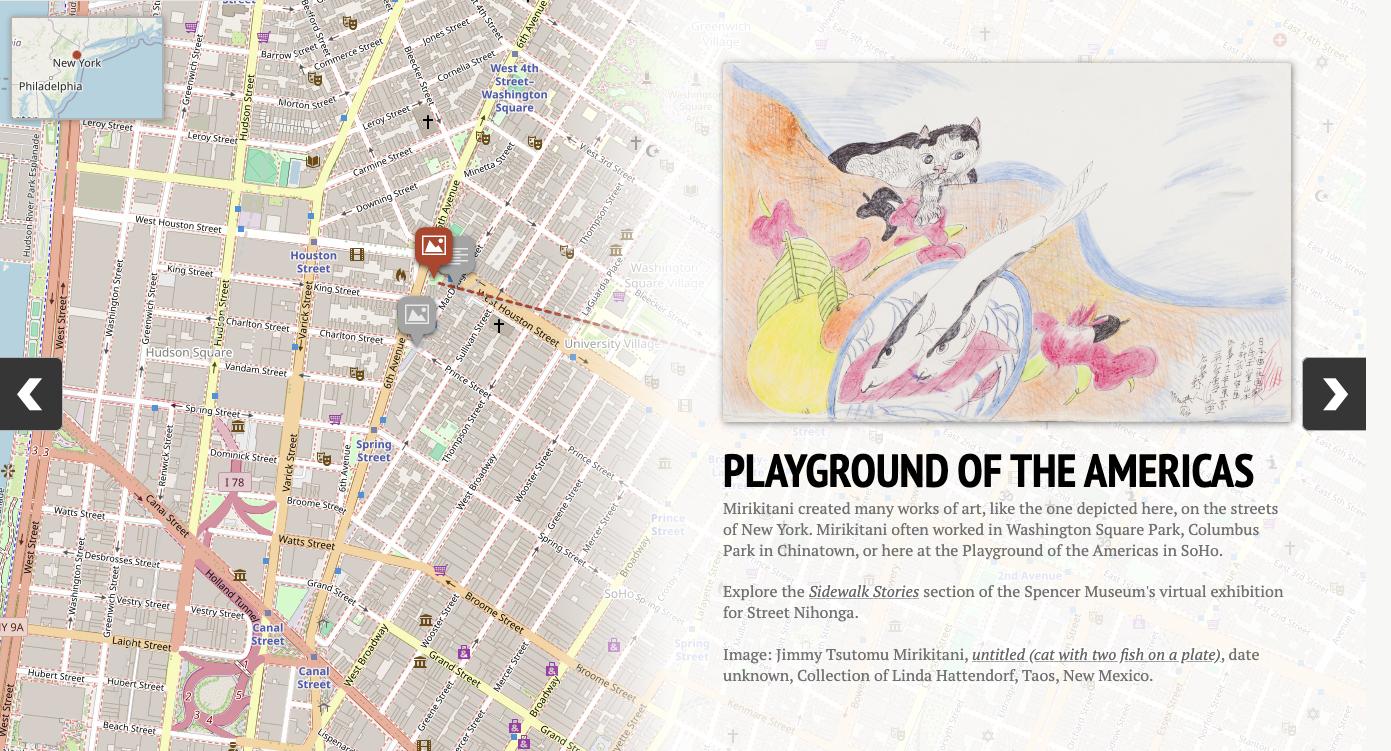
Mapping the life of Jimmy Tsutomu Mirikitani
This interactive feature maps Mirikitani's life with key sites in Japan, as well as the West and East coasts of the United States. Learn about how these places influenced his work.