86 Bends of the Kaw, Lisa Grossman
Artwork Overview
Object Height/Width (Height x Width): each panel 203.2 x 33.02 cm
Object Height/Width (Height x Width): 80 x 16 in
Weight (Weight): each panel 15 lbs
If you wish to reproduce this image, please submit an image request
Images
Label texts
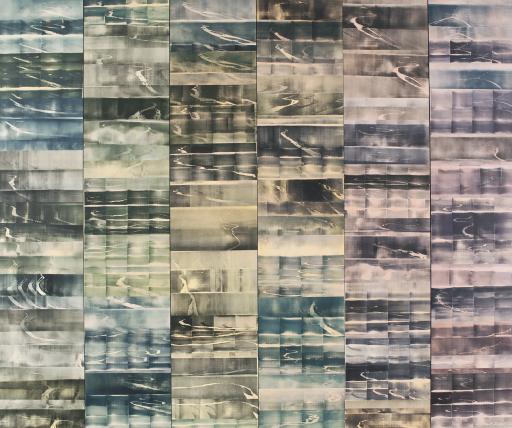
The images that make up this print show different bends of the Kaw River, also known as the Kansas River. The river runs east from Junction City, Kansas, to Kansas City, Kansas, where it flows into the Missouri River. Kaw is the name of the Native American people who lived in the most northeastern territories of present-day Kansas in the mid-18th century. Kansas was named by Europeans who referred to these native people as Kanza or Kansa. The river runs through the state capital of Topeka, among many other towns in eastern Kansas. The artist hopes her work will encourage conservation of natural waterways.
What do you do to help the environment?
What memorable things have you seen in nature?
This work ambitiously documents Grossman’s experience flying east to west over the Kaw River. She mounted a series of small woodcuts that she made from the trip onto wood panels, conveying the bends and shapes of the Kaw River valley as witnessed during a sunset.
In this work, Lisa Grossman ambitiously documents the 86 bends in the Kansas River, or Kaw, as seen at sunset from a low-flying airplane. The Kaw River runs through much of northeast Kansas, reflecting on the variation of water levels within a single season, through drought and flood, and the constant movement of water eastward, ultimately emptying into the Missouri River at Kansas City. She later mounted the series of small woodcuts onto wood panels, conveying the bends and shapes of the Kaw River valley.
This work ambitiously documents Grossman’s experience flying east to west over the Kaw River. She mounted a series of small woodcuts that she made from the trip onto wood panels, conveying the bends and shapes of the Kaw River valley as witnessed during a sunset.
Exhibition Label:
"Conversation XIV: Water,” Mar-2013, Kate Meyer and Kris Ercums
This work ambitiously documents Grossman’s experience flying east to west over the Kaw River. She mounted a series of small woodcuts that she made from the trip onto wood panels, conveying the bends and shapes of the Kaw River valley as witnessed during a sunset.
Exhibition Label:
"Site Specifics,” Aug-2010, Susan Earle
This work ambitiously documents the 86 bends in the Kansas River, or Kaw, as seen at sunset from a low-flying airplane. The artist flew from east to west as darkness almost fell. She later mounted the series of small woodcuts that she made from the trip onto wood panels, conveying the bends and shapes of the Kaw
River valley. Based in Lawrence, Kansas, Lisa Grossman grew up in Pennsylvania and moved to Kansas City in 1988 to work as an illustrator for Hallmark Cards, Inc. She shifted her focus to plein air, or open air, painting when she discovered the tallgrass prairies of east-central Kansas, leaving Hallmark in 1995 to pursue
painting full-time. She received a BFA from the University of Kansas in 1999.
“I see my work as a sustained meditation on open spaces, as a celebration of their sublime beauty, as an expression of my deep concern for their survival. Painting en plein air is a necessity for me. It allows me to work in a very direct manner, drawing energy from my surroundings and translating it into paint.”
-Lisa Grossman
Exhibition Label:
"A Kansas Arts Sampler," Oct-2004, Kate Meyer
Grossman’s ambitious documentation of this Kansas waterway is based on the artist’s experience flying from east to west along the river. The colors increase in warmth and darkness from left to right and top to bottom as the sun set on her flight while ghost images from the roller used to ink Grossman’s woodcut blocks suggest captured motion and lingering memory.
Exhibition Label:
"Summer in the Central Court," Jun-2006, Kate Meyer
Unlike corn and oats, which are harvested in the fall, farmers harvest wheat during May and June. Ripened wheat forms a golden ocean of grain we imitate with waving arms. The rippling stalks soon become spiky chaff as combines alter the appearance of fields like paintbrushes pulled across a vast canvas. The planting process is one of change - equipment has become more mechanized, crops are rotated to balance the soil. Thunderheads on the skyline transform our landscape radically during the timeframe of a single afternoon. Summer storms threaten not only the harvesting process but also may damage crops. The rains that may strip and flatten ripe wheat are essential earlier in the season. Spring rains swell our streams and rivers as flash flood warnings hover in the margins of television sets. The Kaw River that runs through much of northeast Kansas reflects the changes of a single season as water levels vary through drought and flood and the relentless motion of water meanders eastward, ultimately emptying into the Missouri River at Kansas City. Our bridges and levies attempt to contain rivers, although the floods of 1951 and 1993 demonstrate nature’s ability to chart its own path.