Ingrid & J.K. Lee Study Center
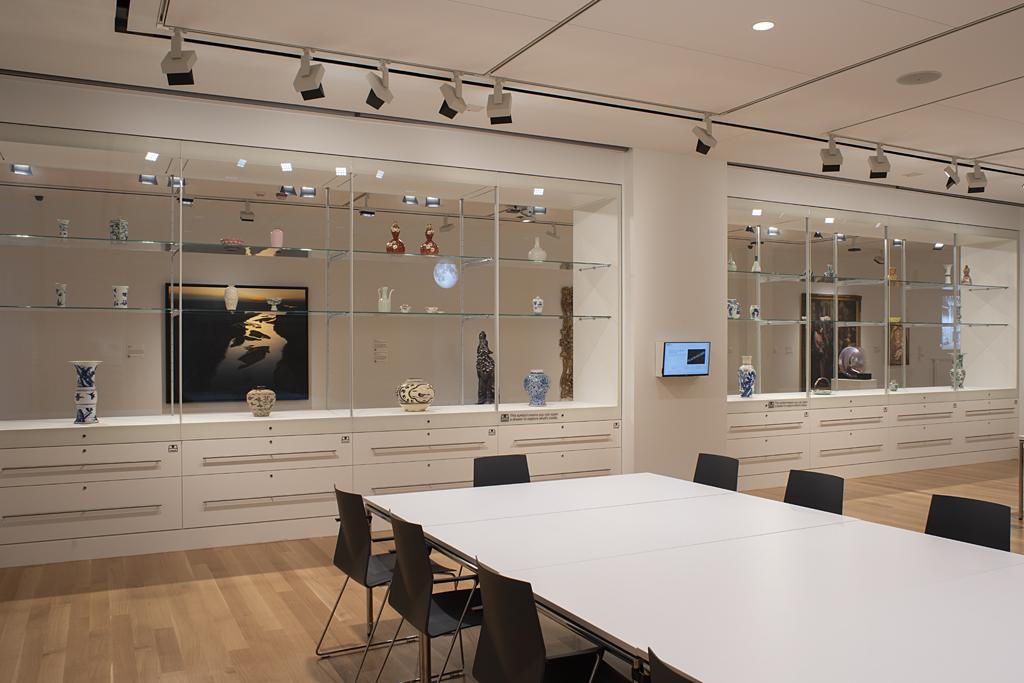
Use this webpage to explore the objects in the cases and drawers in the Ingrid & J.K. Lee Study Center. Tap the links below to jump to the shelf or drawer you want to learn more about, and use the "back to top" buttons throughout the page to return here.
Lee Center jump links
Form & Flux: Contemporary East Asian Ceramics
In East Asia, contemporary ceramics blend centuries-old traditions with innovative artistic expression, reflecting a dynamic evolution in form, technique, and approach. By pushing the boundaries of utility and sculpture, artists reimagine ceramics with bold colors, experimental glazing, and abstract forms that challenge conventional notions of pottery. This fusion of history and modernity has garnered global recognition, positioning ceramics at the intersection of craft, fine art, and cultural identity in the 21st century.
1
untitled (88/01), Seto Hiroshi

17788 label
Seto Hiroshi studied at Kyoto Geijutsu Daigaku under Living National Treasure Tomimoto Kenkichi, who encouraged students to develop their own voice in pottery. After graduating in 1964, Seto moved to Mashiko to study under another Living National Treasure, Hamada Shōjiro. Initially working in the folk tradition with salt glazing, Seto's style evolved after international travels and teaching in the United States. By the 1980s, he focused on sculptural forms, like this piece, featuring undulating gold and silver stripes over a rich purple surface.
2
covered vessel, 김익영/金益寧 Kim Yik-yung
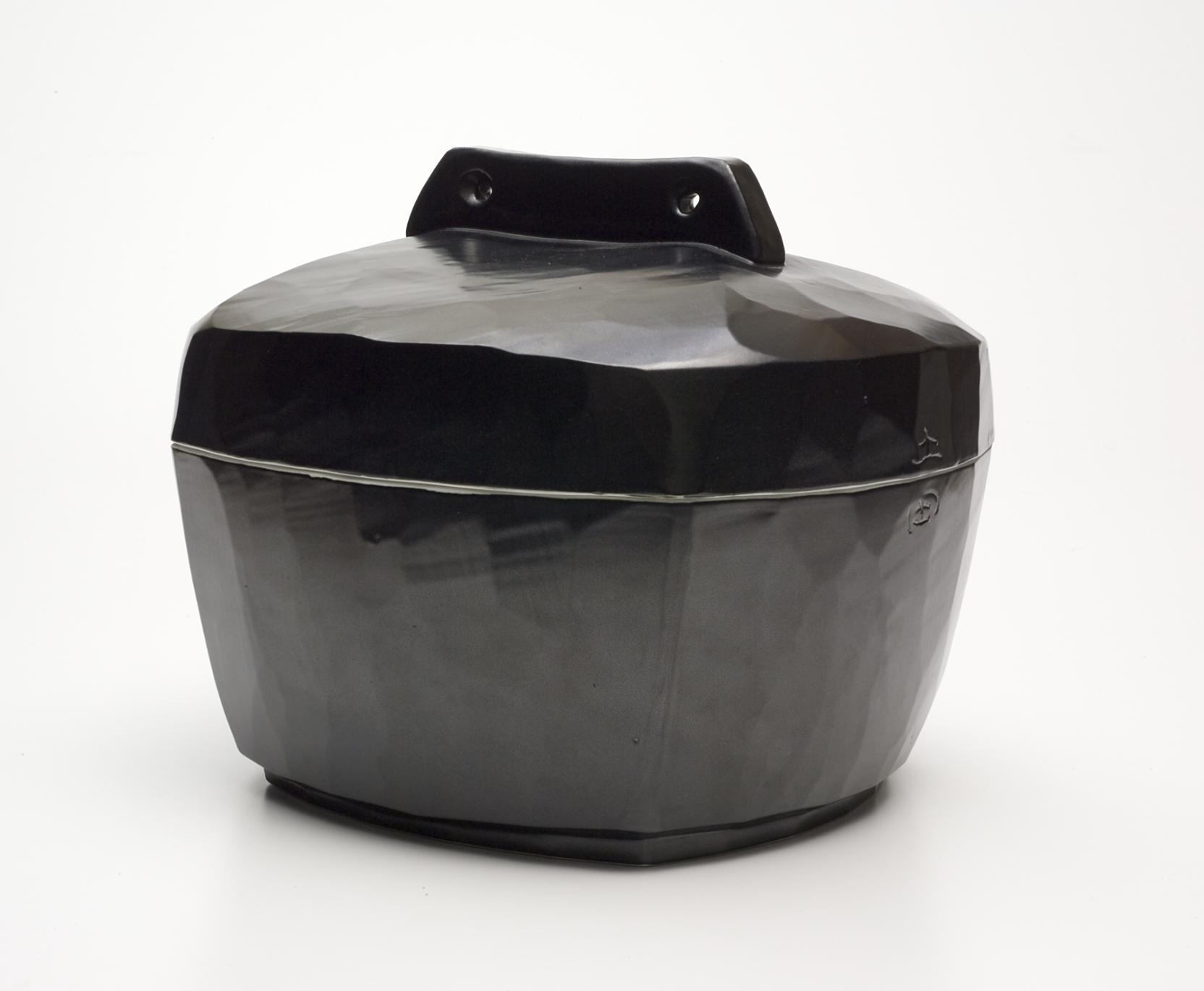
2008.0281.a,b label
Kim Yik Yung's Covered Vessel reinterprets Joseon period (1392–1897) ritual vessels with a modern, sculptural approach. Influenced by the minimalistic forms of Joseon porcelain, her metallic black glaze recalls ancient Chinese ritual bronzes. Using a knife to slice pliable porcelain, she imparts a structured texture to the soft material. Kim merges traditional forms with contemporary design, creating bold, faceted vessels that balance clarity and simplicity. Her work bridges Korea’s historical ceramics with modern expressions, gaining international acclaim.
3
large globular vase, Yoshikawa Masamichi

2015.0025 label
Yoshikawa Masamichi is known for his seihakuji, or “blue-white” glazed ceramics, where he combines bold, thick forms with sophisticated glazing techniques. This large globular vase exemplifies his early exploration of dense clay work, contrasting traditional celadon’s delicate thinness with a more substantial, sculptural approach. The piece reflects his fascination with the interplay of form and glaze, highlighting his ability to blend technical mastery with a unique, bold aesthetic that distinguishes his ceramics.
4
Clone 07-4, Xu Hongbo

2008.0211 label
Xu Hongbo merges his birthplace's porcelain legacy with contemporary themes in Clone 07-2, a twisting mass of mutated porcelain arms, legs, torsos, heads, and genitalia glazed in Qingbai (blue-white) and arranged into a tumbling pyramid. Xu addresses issues like overpopulation and stem-cell research. This piece can also be displayed upside down, reflecting its subversion of traditional symbols of prosperity and fertility while commenting on China's One Child Policy and broader societal shifts, evoking global and local concerns.
5
celadon bowl with foliated rim, Kawase Shinobu

1995.0019 label
Kawase Shinobu, a third-generation potter, hails from a family renowned for its technical mastery. His grandfather’s blue-and-white porcelain technique was classified as an Intangible Cultural Property in 1955. Shinobu originally trained as a painter but chose to pursue pottery under his father’s guidance at their Kyoto kiln. Known for his delicate celadon glazes, this bowl exemplifies Shinobu’s skill, with its luminous glaze and playful, foliated rim, showcasing his refined approach to form and texture.
6
vase, Matsumoto Isami

1989.0021 label
Matsumoto Isami is a Kyo-ware potter who studied porcelain, celadon, and enamel techniques from his father. Kyo-ware—an elegant, often intricately decorated style of ceramics originating in Kyoto—reflects refined craftsmanship and artistic detail. Matsumoto’s work blends traditional Japanese methods with modern aesthetics. This piece features his signature low-relief decoration with stylized clouds enhancing the surface. His mastery of form and texture reflects a distinctive approach rooted in heritage, reimagined through a contemporary lens.
7
vase, Miyashita Zenji
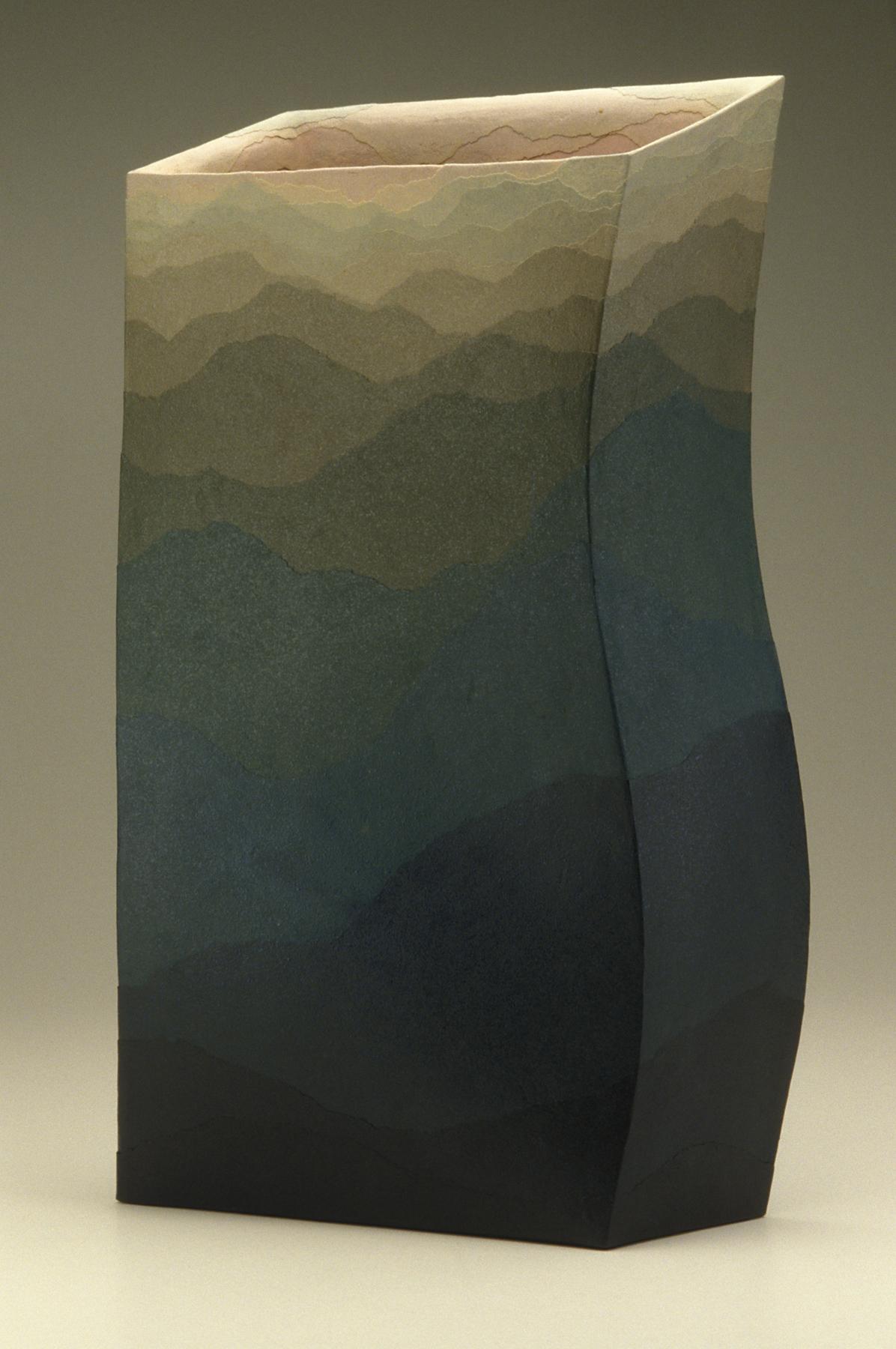
1989.0019 label
Miyashita Zenji is celebrated for his non-traditional vase shapes and ceramic sculptures, distinguished by intricate layering of clay slip. In this piece, the tall rectangular vase is subtly bent into an organic curve, echoing the natural form of layered mountains that embellish its surface. The layered slip creates texture and depth, enhancing the sense of movement and transformation in the piece, reflecting Miyashita’s innovative approach to ceramics and his deep connection to the natural world.
8
Bridge of Phantom, Tsuboi Asuka

2006.0093 label
Tsuboi Asuka broke into the male-dominated world of Japanese ceramics early in her career. After a 1966 trip to China, where she witnessed the harsh use of self-criticism during the Cultural Revolution, she began creating conceptually driven ceramics that questioned women’s roles in Japanese society. In this work, she transforms the delicate, pliable form of a traditional kimono bag into a solid, substantial piece, reflecting her investigation into femininity and material culture.
Tea Pot with Eggplant, Matsuda Yuriko
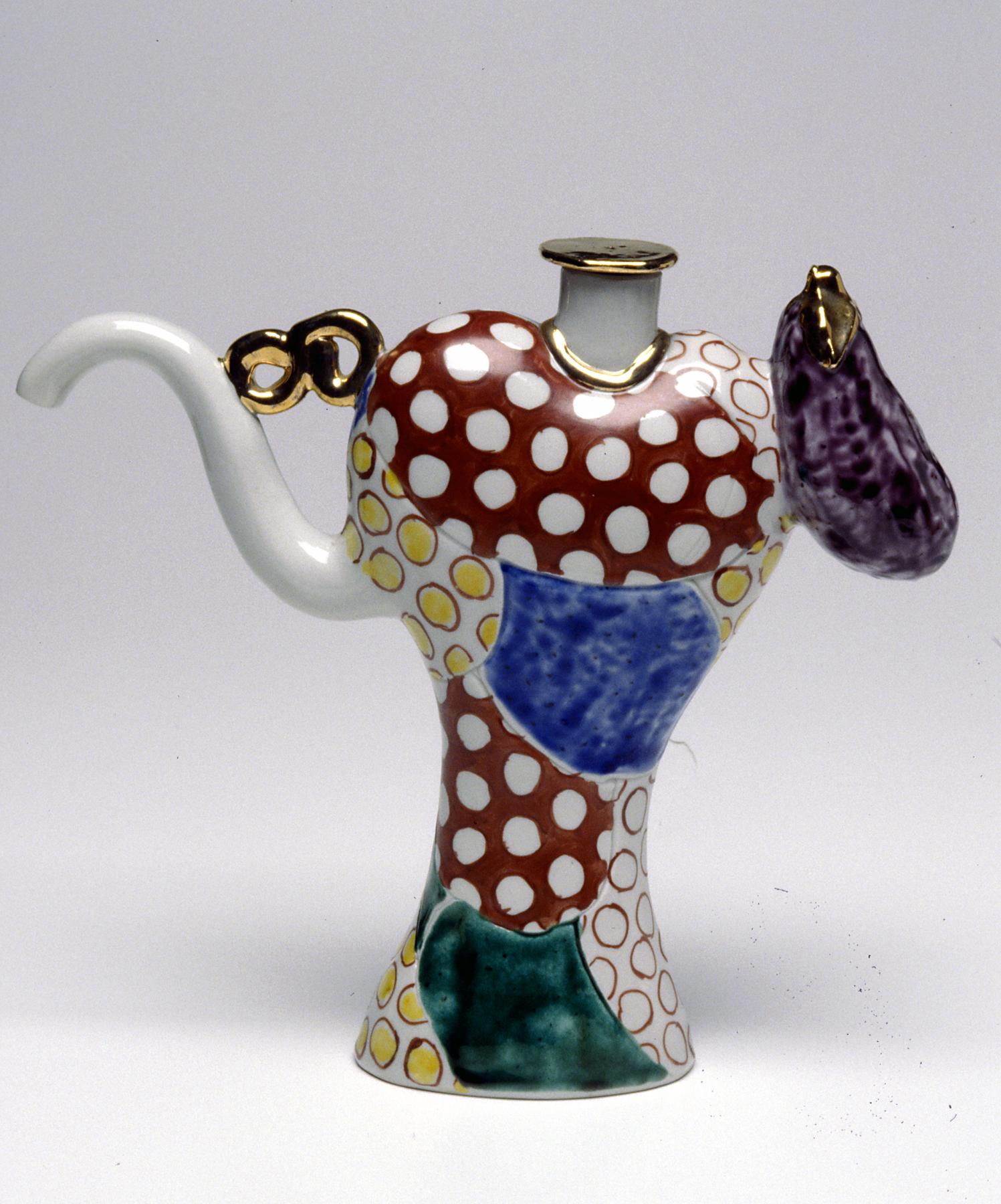
2002.0002 label
Matsuda Yuriko’s whimsical approach blends imaginative additions, like the eggplant handle, with classic forms such as a teapot, blurring the line between tradition and innovation. Drawing on porcelain techniques from Ming China and Japanese Imari and Kutani kilns, she transforms functional objects into quirky, animated sculptures. Studying at Kyoto City University of Arts under Living National Treasures Tomimoto Kenkichi and Kondo Yozo, Matsuda’s colorful work also reflects Japan’s textile heritage and her garden, with the eggplant handle molded directly from her harvest.
9
vessel, Ikeda Yoshiro

1991.0159 label
Yoshiro Ikeda’s sculptural vessels, characterized by organic forms and textured surfaces, draw inspiration from Zen aesthetics and the expressive qualities of California ceramics. Ikeda immigrated to the United States in 1960 and earned an MFA in ceramics from the University of California, Santa Barbara. He also studied at Kyoto City University of Arts under renowned ceramist Yagi Kazuo. Ikeda served as a professor of ceramics at Kansas State University from 1978 to 2012, becoming a Distinguished Professor in 2004.
10
Square Vase, Choi Sung-jae

2008.0038 label
In this work, Choi Sung-jae reinterprets classical Korean Buncheong ware, a 15th-century stoneware. After applying a white slip to the gray clay, Choi uses various tools, from reeds to fingers, to create dynamic imagery of reeds and ducks. This expressive brushwork and carving echo traditional calligraphy and ink painting, infusing Korean art with a modern sensibility. Choi's vessels, made using press-molds, reflect the spontaneity and simplicity of literati traditions in East Asia.
11
bowl, Toshiko Takaezu

2003.0120 label
Toshiko Takaezu was a pioneering Japanese-American woman artist who helped redefine ceramics as a sculptural medium. At a time when the field was dominated by men, she brought a distinctly personal and intuitive approach to clay. While best known for her closed, globular forms, this bowl shows her painterly sensibility, with brushed glaze cascading down the sides like dripping water. Merging abstraction, nature, and spirituality, Takaezu’s work reflects a lifelong devotion to clay as both craft and art.
12
Third River, Dong Hee Suh

Teapot of Humor, Dong Hee Suh
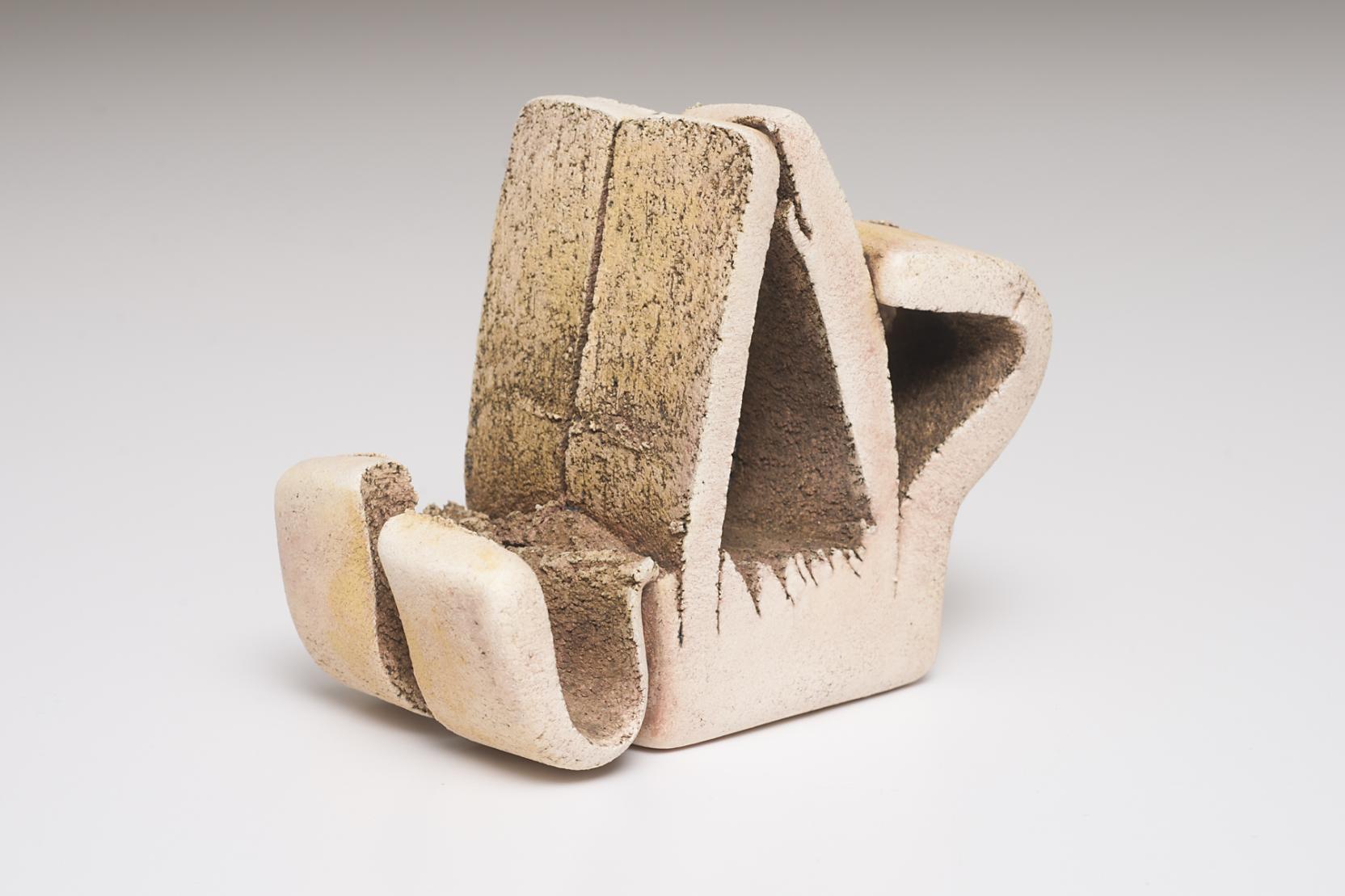
2011.0480-0481 label
After earning her MFA from Seoul National University in 1972, Suh Dong Hee came to Lawrence, Kansas, for a second MFA at KU under Jim Leedy. Here she developed her signature technique: slicing solid masses of clay into ribbon-like segments to reveal mysterious, expressive interiors. Sculptural works like Third River and Teapot of Humor reflect this process and embody Suh’s metaphysical vision, inspired by biblical texts. Her clay forms merge Korean heritage with global contemporary practice.
13
Saint’s Garment No. 5, 金重晃介 Kaneshige Kōsuke (born 1943)

2026.0006 label
Kaneshige Kōsuke, son of Living National Treasure Kaneshige Tōyō, trained as a sculptor at Tokyo University of the Arts before forging his own voice in Bizen ware—an unglazed stoneware tradition dating back over a thousand years. Saint’s Garment, part of a series evoking sacred robes, was formed by draping combed clay over a diamond-shaped box. Though rigid, its folds suggest flowing cloth. Fired in wood kilns, its warm surface reflects both lineage and innovation.
14
untitled, Takiguchi Kazuo

1998.0014 label
Takiguchi Kazuo creates this metamorphic vase by draping flattened sheets of clay over molds, then shaping them from within while refining the exterior. He defines the vessel by cutting, joining, or removing sections of clay, creating an interplay of form and void. A vertical slice links the vessel’s interior with the surrounding space, inviting both light and reflection. The somber matte glaze enhances the subtle contrast between interior and exterior, presence and absence, concealment and revelation.
15
vase, Osako Mikio
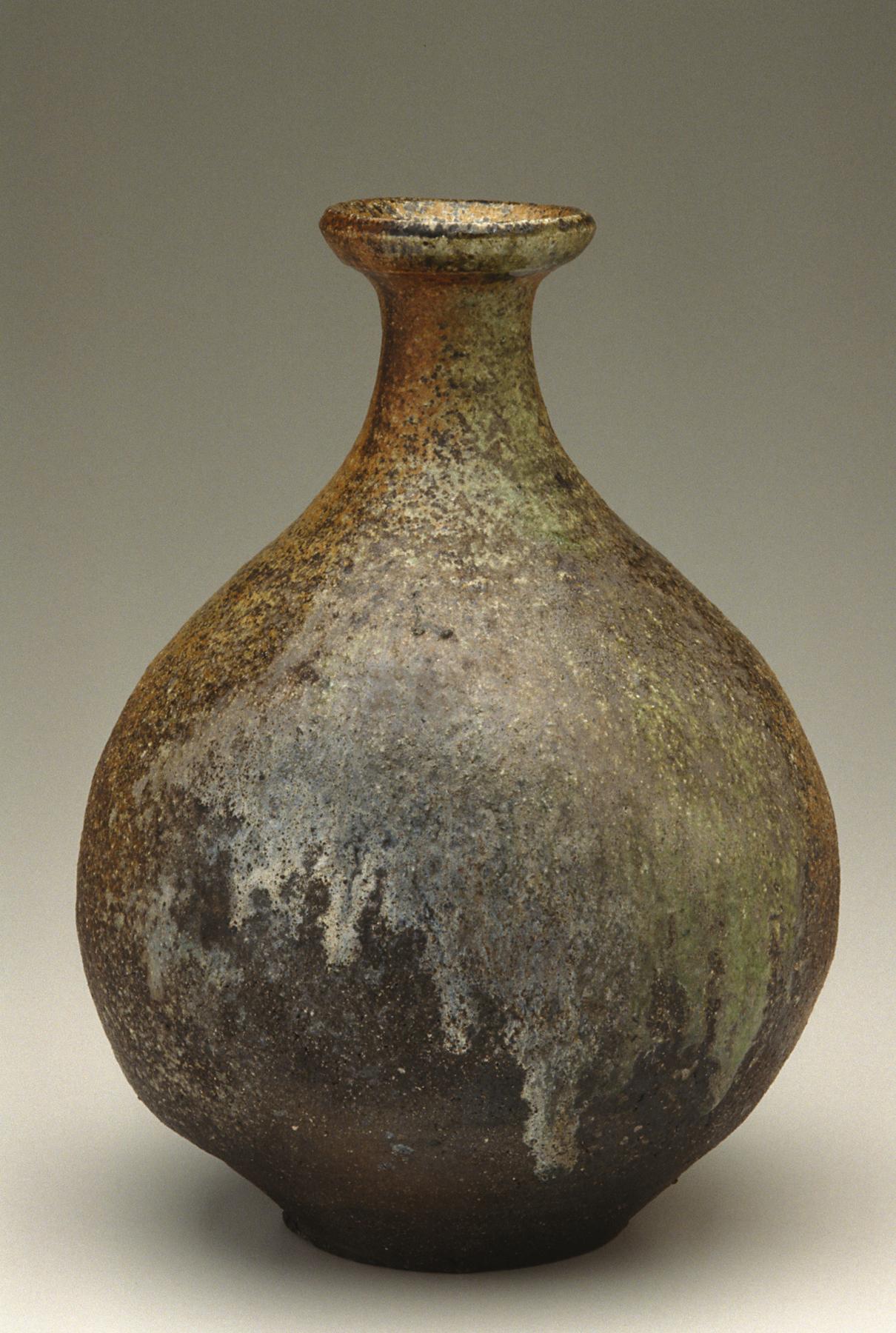
1992.0074 label
In 1982, Osako Mikio built a kiln in Tokoname, a historic ceramics center in Aichi Prefecture, Japan. Inspired by Ezaki Issei, who revived ancient wood-firing techniques after World War II, Osako uses local clays and ash glazes. He fires his pots twice—first in a wood-fired kiln, then in an electric kiln with ash and rice husks—creating distinctive, dripping glazes. His flasks, often used for serving sake or storing liquids, balance bold forms with refined surfaces.
16
square bowl, 加藤委 Katō Tsubusa (born 1962)

2026.0007 label
Born into a pottery lineage dating to the Momoyama period (1573–1615), Katō Tsubusa found his own path to ceramics after traveling abroad. He trained at the Tajimi City Ceramic Design Institute and, by 1984, had established his own kiln. Now working exclusively with New Zealand clay, Katō carves and reconstructs his forms with raw intensity. His square vessels pair jagged exteriors with smooth, blue-glazed interiors, embracing imperfection while balancing energy, serenity, and sculptural depth.
17
茶碗 chawan (tea bowl), Kuwata Takurō

2018.0008 label
Kuwata Takurō’s radical ceramics are rooted in tradition yet embrace experimentation and chance. His oddly elegant tea bowls—central to his practice—reinterpret classical forms using extreme techniques like ishihaze (stone explosion) and needle-scored glazes. Metallic glazes, including gold and silver, form cracked, blistered surfaces that suggest both opulence and rupture. Joyful yet unsettling, Kuwata’s work reflects the contradictions of contemporary life while honoring centuries-old Japanese ceramic traditions.
18
vase, 森野泰明 Morino Hiroaki Taimei

1989.0020 label
While known for ceramic sculpture, Morino Hiroaki also creates refined functional works. This square vessel features a bold red abstract design, balancing expressive surface with subtle form and color—hallmarks of his distinctive artistic language. Morino gained international recognition with a solo exhibition at the Art Institute of Chicago in 1963 during a teaching residency at the University of Chicago. A graduate of Kyoto City Art University, he studied under Living National Treasure Tomimoto Kenkichi.
19
Frozen Cloud II-8, Satoru Hoshino

2018.0161 label
Renowned for his raw, elemental installations, Kyoto artist Hoshino Satoru emphasizes clay’s natural energy and origins. Once part of the avant-garde Sōdeisha group, his approach shifted after a 1986 landslide destroyed his studio. He began to see clay not just as material, but as a force of nature with its own vitality. Frozen Cloud embodies this philosophy—its spiral form reflects natural motions like tornadoes or hurricanes, capturing the dynamic essence of the earth itself.
20
vase, Onodera Gen

1991.0052 label
Onodera Gen seeks a quiet, natural beauty—one that reveals itself gradually. Fascinated by clay’s origins, he travels Japan to dig his own and study its geological formation. Visitors describe his studio as a geological lab, filled with labeled rocks. His forms are simple, even austere. In this vase, he inlaid white and gray clays into incised grass-like lines, then added vertical cuts, partially erased, creating a subtle, layered surface that rewards close, patient viewing.
21
Namban mizusashi (Namban water jar with lid), Kabasawa Kenji
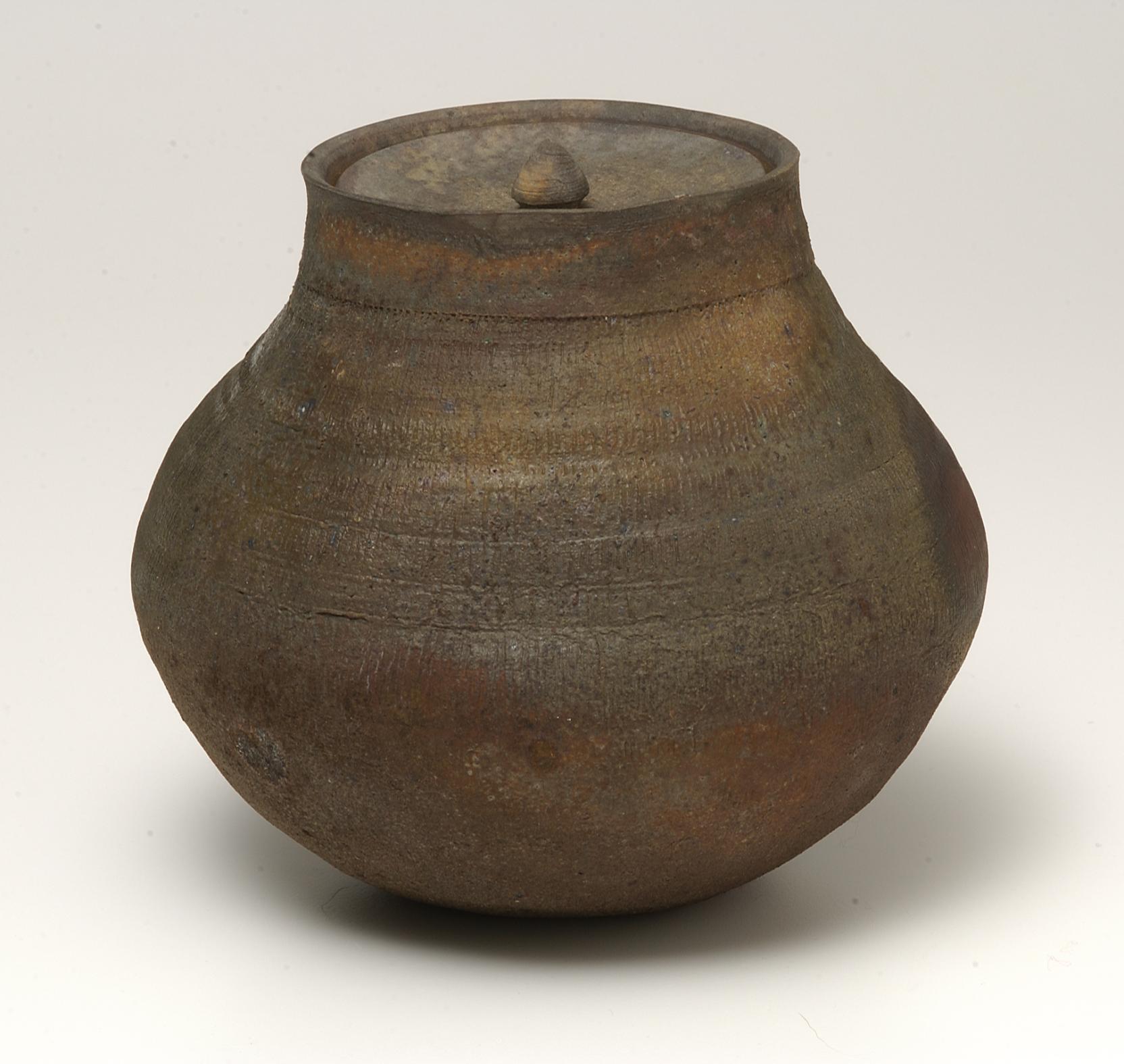
1999.0025 label
This simple yet sturdy mizusashi (water jar) reflects Kawasawa Kenji’s commitment to the tea ceremony. He uses a traditional wood-fired climbing kiln (noborigama), designed with multiple chambers built on a hillside to channel heat. In 1986, he constructed a more primitive snake kiln (jagama), named for its serpentine shape. Kawasawa’s most striking works, like this Namban Water Jar, are unglazed, high-temperature fired pieces, showcasing a raw, elemental beauty shaped by the kiln’s intense heat.
22
faceted flower vase, Tsujimura Shirō

2001.0044 label
This flower vase recreates Iga-yaki, a high-fired ware favored by tea masters during the Momoyama period (1568–1615). Carved from a solid block of Shigaraki clay using a long fish knife, the vase’s intricate texture and glaze result from a volatile process involving ash and an oxygen-starved kiln atmosphere. Known for embracing the unpredictable, Tsujimura Shirō has said, “It is in the last fifteen minutes of the firing that I win or lose,” highlighting his risk-taking in the firing process.
23
tsubo, Itō Sekisui V
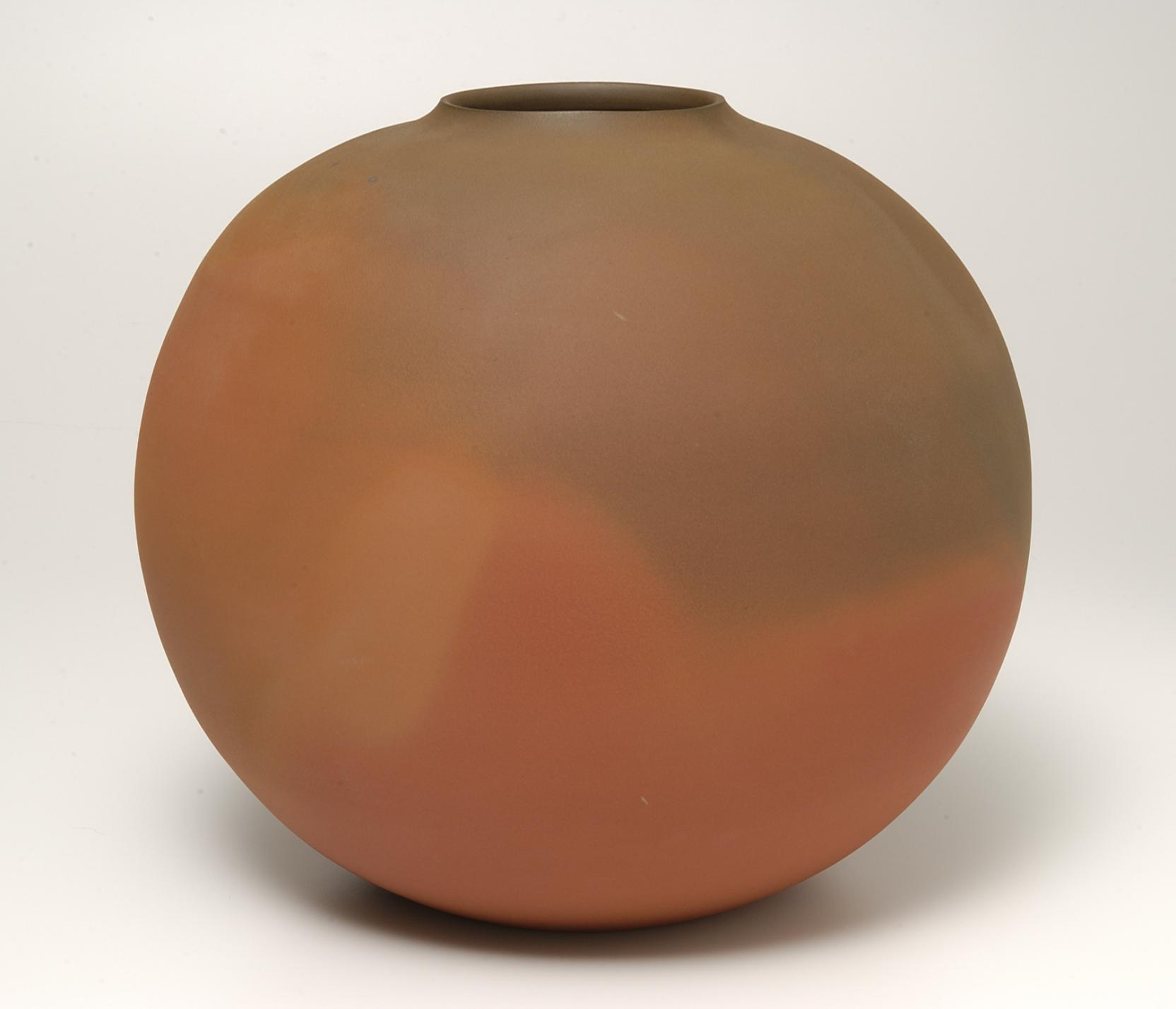
1989.0018 label
Itō Sekisui, a fifth-generation potter from Sado Island, carries on his family’s tradition of crafting Mumyoui-yaki, a delicate, reddish-brown porcelain. The clay, historically sourced from gold mines, was also used for medicinal purposes. Itō’s innovation lies in directing kiln flames to create striking red and black contrasts, while layering colored clay to add depth. His work reflects a modern interpretation of his family’s legacy, blending natural firing effects with contemporary design techniques.
24
Yeollimun bottle, Roe Kyung Jo

2015.0043 label
Roe Kyung Jo is renowned for his innovative approach to clay. He trained under art historian Kim Youngki at Kyung Hee University in Seoul, where he mastered various Korean ceramic techniques, including yeollimun or "marbling." This ancient method, originating in China during the Tang dynasty and later used by Korean potters in the Goryeo dynasty, involves mixing porcelain and stoneware to create multicolored, veined patterns resembling marble. The technique vanished by the 13th century due to its complexity.
Surface Stories
Surface Stories explores the expressive potential of contemporary ceramics through decoration, texture, and imagery. Featuring a diverse range of artists, the exhibition highlights how surface treatments—whether painted, carved, glazed, or printed—can transform clay into a narrative medium. From bold patterns and layered iconography to subtle marks and tactile finishes, these works reveal how artists use surface as a space for storytelling, cultural reference, and personal expression. Together, they challenge the notion that ceramics are purely functional, showcasing instead how surface can be a site of depth, dialogue, and meaning.
25
Caravaggio's Medusa with pasta, Vik Muniz
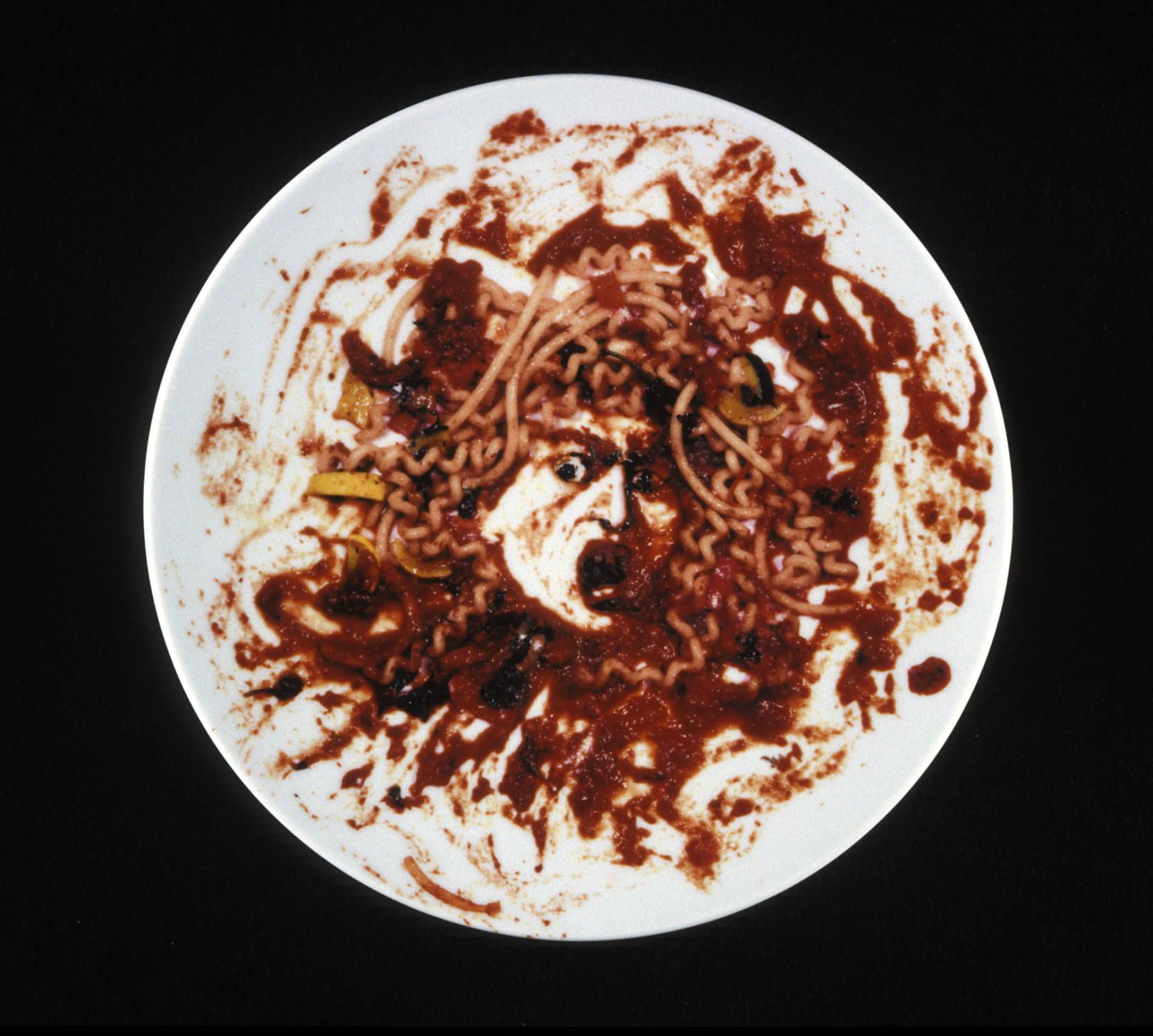
1999.0345 label
Vik Muniz, a Brazilian artist known for creating intricate illusions from everyday materials, uses his art to explore deceptive visual information. On this plate, Muniz recreates the 16th Century Italian artist Caravaggio’s iconic painting of Medusa using pasta sauce, emphasizing the tension between representation and material. By transforming a mundane object into a masterpiece, Muniz, who likens himself to an alchemist, creates visual magic that challenges perceptions and highlights the transformative power of art.
26
Rustic Basin, Bernard Palissy and Workshop

Palissy label
Motivated by scientific curiosity, Bernard Palissy created ceramic plates and basins that record the natural world in vivid detail. Using molds taken from real plants and animals, this Rustic Basin transforms the surface into a textured landscape of frogs, fish, and foliage. Its dense, high-relief forms turn clay into a site of observation and storytelling, revealing how surface decoration can function as both scientific document and imaginative, narrative terrain.
27
Jacqueline at the Easel, Pablo Picasso

1991.0085 label
In 1956, Pablo Picasso created this ceramic plate, Jacqueline at the Easel, at the Madoura Pottery workshop in Vallauris, France. This piece features his second wife and muse, Jacqueline Roque, depicted at an easel—a reversal of traditional roles that emphasizes her significance in his life and work. The design showcases Picasso's signature Cubist style, with abstracted forms and fragmented perspectives, highlighting his innovative approach to ceramics and his deep connection with Jacqueline as both partner and artistic inspiration.
28
A-7, Kanō Enryū

2001.0202 label
Kano Enryū’s ceramic circles reference the Buddhist ensō—a symbol of the universe or void—and the wheel of samsara, the Hindu cycle of life and death. Deeply concerned for the planet’s future, Kano works with elemental materials and seemingly primitive processes. Like many of his sculptures, A-7 was fired not in a kiln but in an open bonfire, a method he has shared through public events across Japan and Southeast Asia.
29
The Ancient Mariner, Ynez Johnston
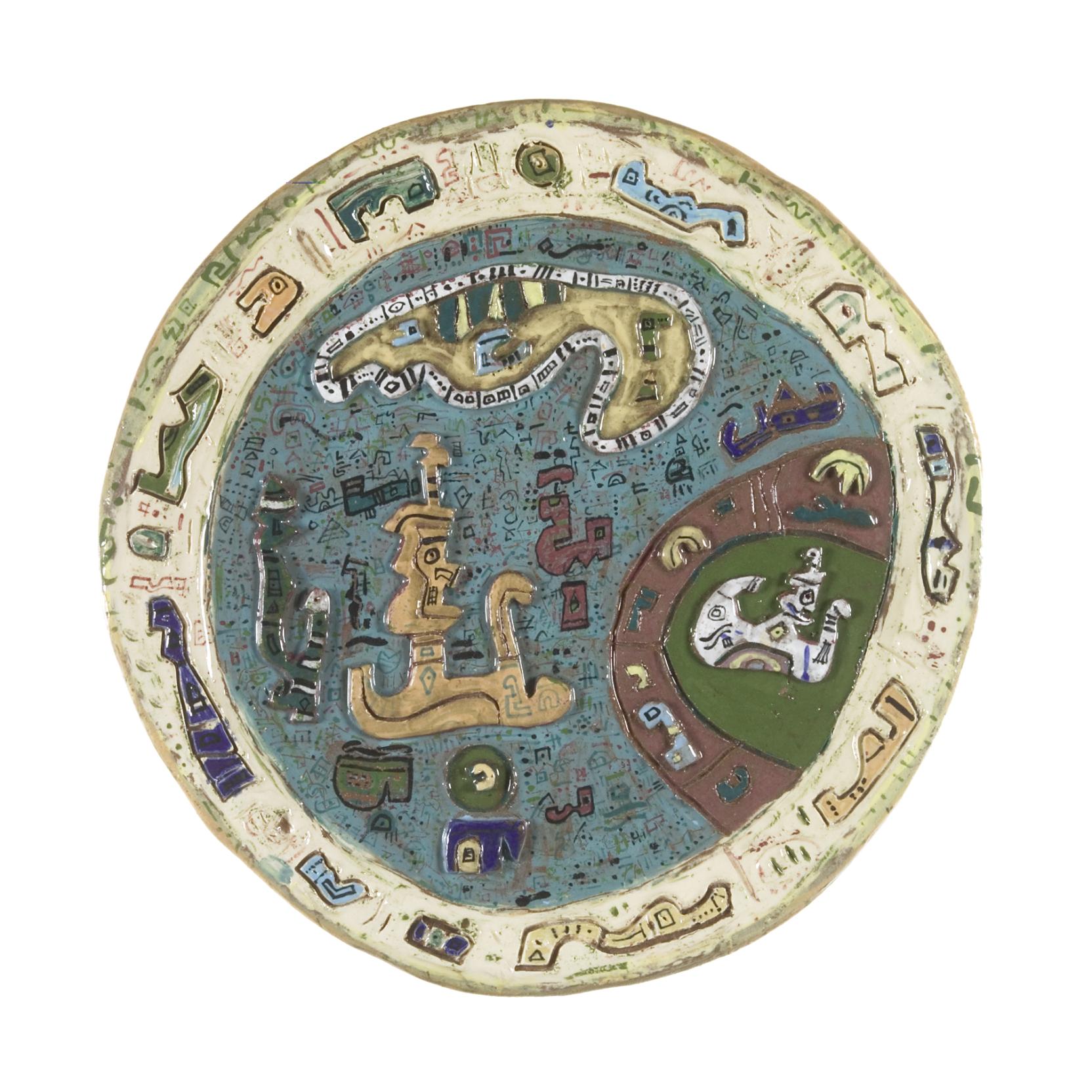
2002.0038 label
Ynez Johnston was a California-born ceramic artist known for blending modernism with ancient influences. Her travels shaped her artistic vision, leading to works that incorporate symbolic motifs and cultural narratives. The Ancient Mariner reflects her fascination with storytelling, inspired by Samuel Taylor Coleridge’s poem “The Rime of the Ancient Mariner.” The plate depicts the mariner’s fateful journey with striking imagery, merging Johnston’s mastery of ceramics with a vivid narrative, enhancing its symbolic and timeless quality.
30
White Trash, Linda Lighton
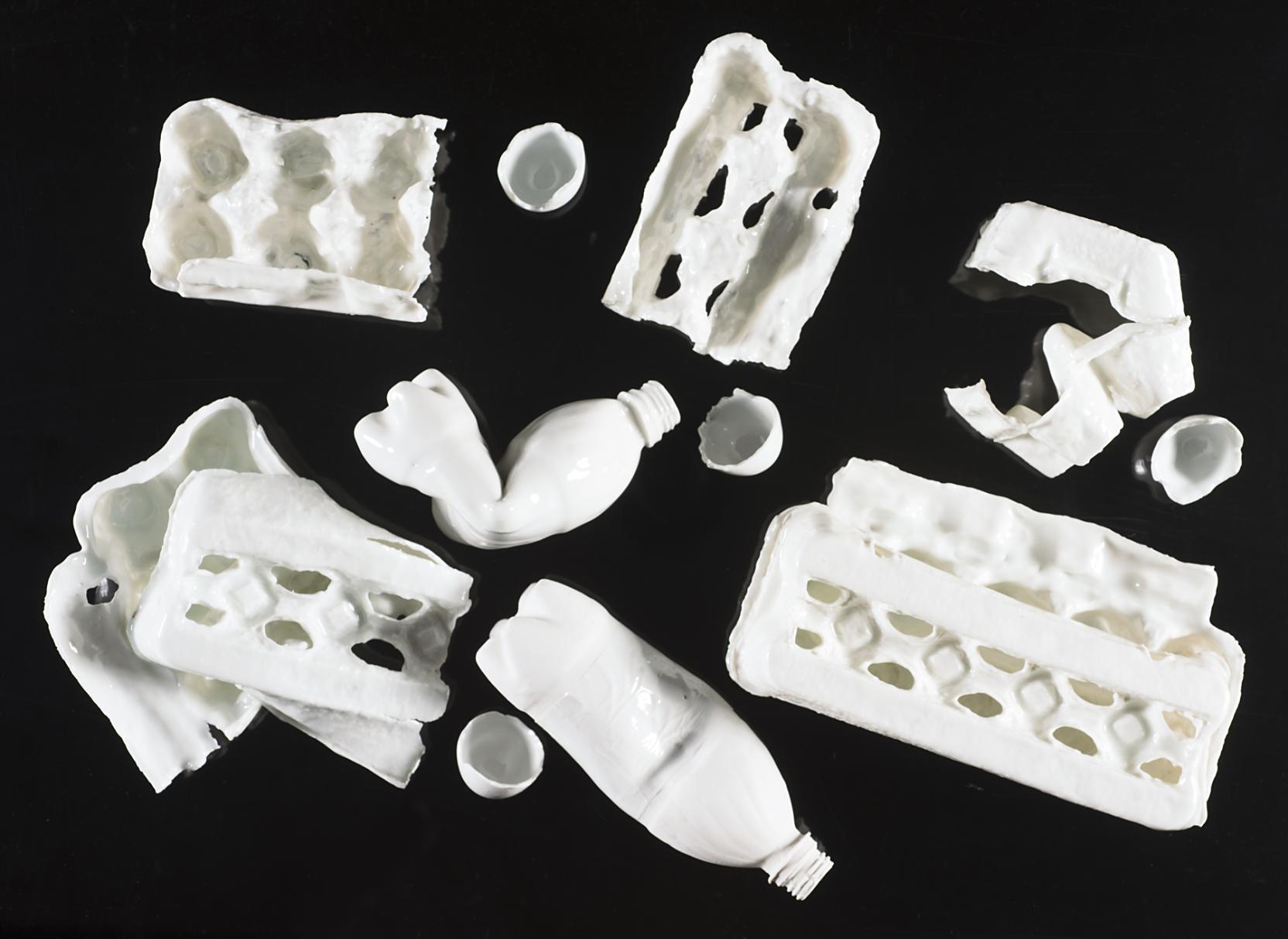
2010.0027 label
By casting discarded packaging and food containers in luminous white porcelain, Linda Lighton transforms trash into fine art, prompting reflection on class, consumption, and invisibility. The work’s title plays on a charged social slur while also evoking the economic conditions that shape what people eat. Confronted with these pristine remnants of waste, viewers are reminded that what society discards does not disappear—it lingers, revealing uncomfortable truths about inequality and the world we inhabit.
31
dinner plate, Enid Seeney; Ridgway Potteries; Tom Arnold

2024.0056 label
Enid Seeney was a British designer renowned for her innovative work in ceramics and household products. She began her career as the first female designer at Spode, which makes tableware, in the 1950s. In 1957, she designed the iconic "Homemaker" pattern for Ridgway Potteries, featuring stylized black illustrations of modern furniture and household items. Manufactured in Staffordshire, England, this pattern became a popular mid-century design, reflecting the era's embrace of modernism in everyday life.
32
plate, Gilbert Portanier
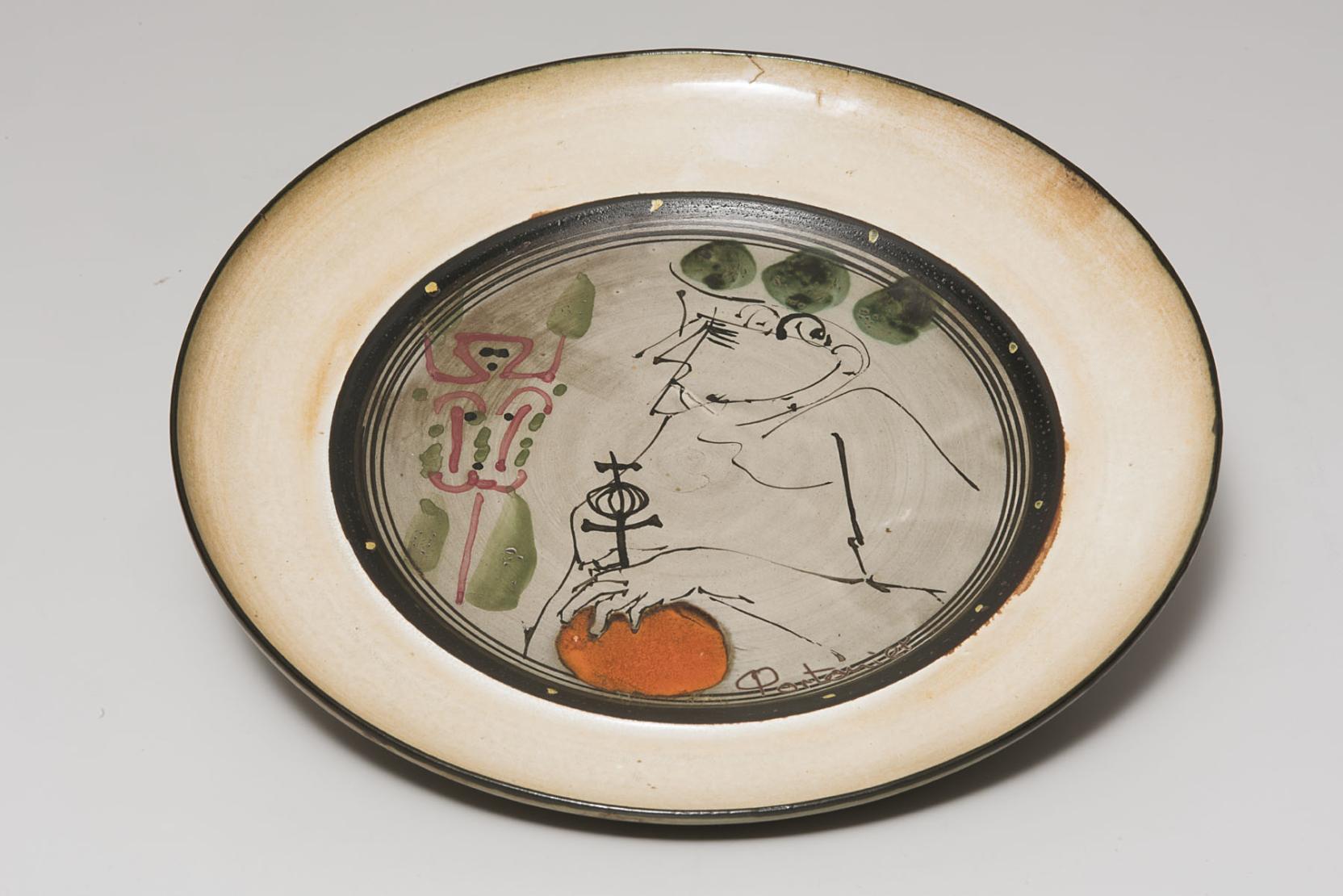
2016.0164 label
Gilbert Portanier, a French ceramist known for his vibrant, painterly works, often blended traditional symbols with contemporary artistic expression. One notable example is this plate depicting a religious figure holding a crossed orb, a symbol of spiritual authority. This piece reflects Portanier’s ability to merge history with modernity, using bold colors and abstract forms. His work earned international acclaim, including the Gold Medal at the 1966 International Ceramics Exhibition, before his passing in 2023.